
What Exactly Is A Turbocharger?
A turbocharger is an air pump — one of the most elegant engineering solutions in the automotive world. It uses waste exhaust gases to force more air into your engine, dramatically boosting power and efficiency.
Free Power From Wasted Energy
In a normally aspirated engine, up to 40% of the fuel’s energy escapes as heat and pressure through the exhaust. A turbocharger captures that wasted energy and puts it back to work.
By spinning a turbine with exhaust gases, the turbo drives a compressor that packs more oxygen into the cylinders. More oxygen means more fuel can be burned — and more fuel burned means more power. That’s how a small 2.0-litre engine can produce the output of a much larger 3.0-litre naturally aspirated one, while using less fuel at cruise.
Modern diesel and petrol engines rely on turbochargers not just for performance — but for fuel economy and emissions compliance too.
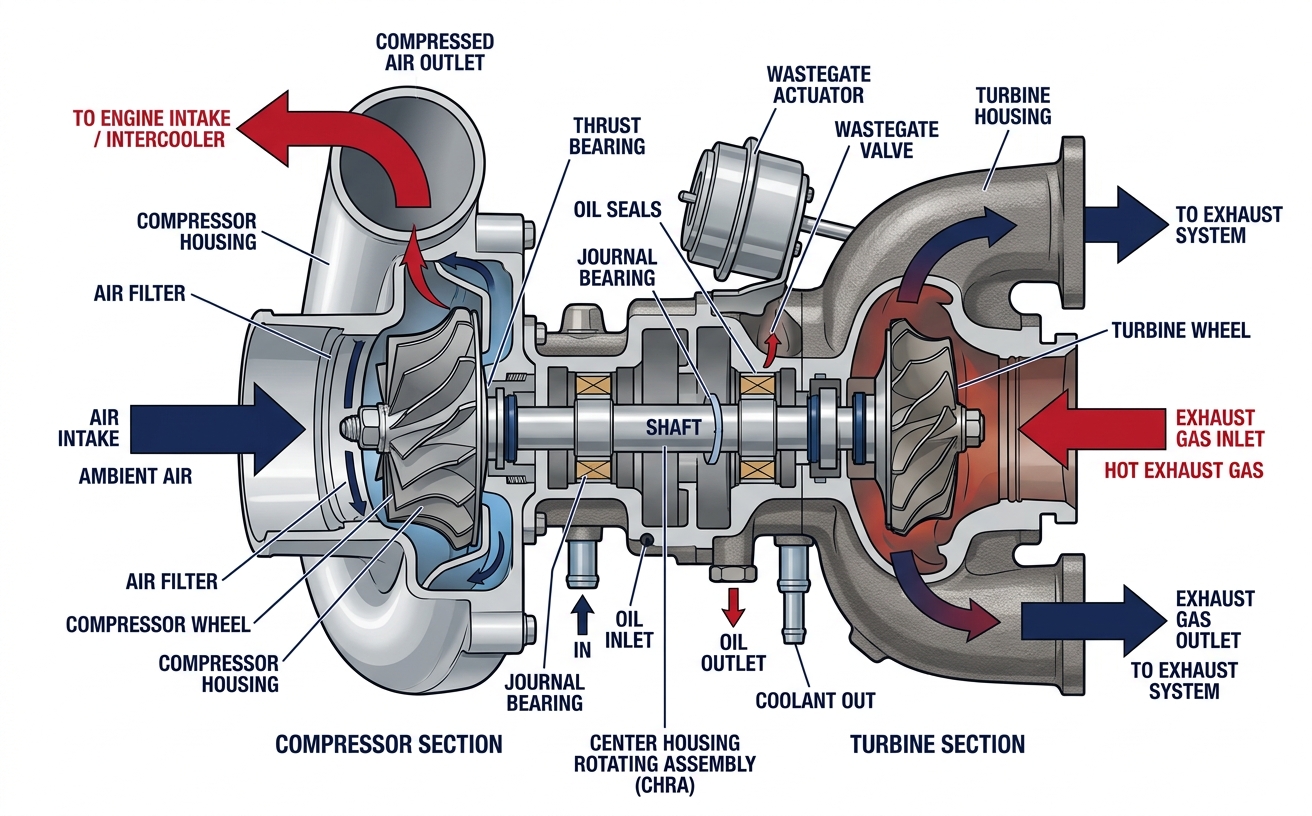
Hot Side & Cold Side
A turbocharger has two wheels on a single shaft — spinning together, doing very different jobs.
The Turbine (Hot Side)
Sitting in the exhaust stream, the turbine wheel is spun by high-pressure exhaust gases exiting the engine. Temperatures here regularly exceed 900°C — glowing red-hot under load.
The turbine housing directs the exhaust flow onto the vanes of the wheel, converting pressure and heat into rotational energy. This drives the shaft that connects to the compressor.
The Compressor (Cold Side)
On the opposite end of the shaft is the compressor wheel. Spinning at up to 200,000 RPM, it draws in outside air and pressurises it before feeding it to the intake.
The compressor housing gathers this compressed charge and routes it — usually through an intercooler — into the engine’s intake manifold, delivering the dense air that produces the “boost.”
Key Turbocharger Components
Every turbo shares the same core anatomy — five components that must work together with micron-level precision.
1. Turbine Wheel & Housing (Hot Side)
The wheel that captures exhaust energy, sitting inside a heat-resistant cast-iron housing. The housing’s A/R ratio determines how quickly the turbo responds to throttle input.
2. Compressor Wheel & Housing (Cold Side)
An aluminium wheel that pressurises intake air, encased in a housing that shapes the airflow. The compressor map defines the turbo’s ideal operating range.
3. Center Housing / Rotating Assembly (CHRA)
The core cartridge — this is where the shaft, bearings and seals live. Oil-fed for lubrication and often water-cooled to survive the temperatures conducted through from the turbine side.
4. Shaft & Bearings
A single hardened shaft connects the two wheels, riding on precision journal or ball-bearing systems. The bearings float on a film of engine oil — no oil, no bearings.
5. Wastegate / VGT Mechanism
The regulator. A wastegate bypasses excess exhaust gas to prevent overboost; on VGT/VNT turbos, movable vanes adjust the exhaust flow angle to optimise performance across the RPM range.
The Numbers Behind Your Turbo
Now That You Know How Your Turbo Works…
Give it the care it deserves. When something feels off, don’t wait — small issues become expensive failures fast.